Talking About Books

Professional reading is a critical part of being a leader, especially when tightly integrated with action.  When we weave together what we are reading with what we are doing, the rate at which we learn can increase dramatically.

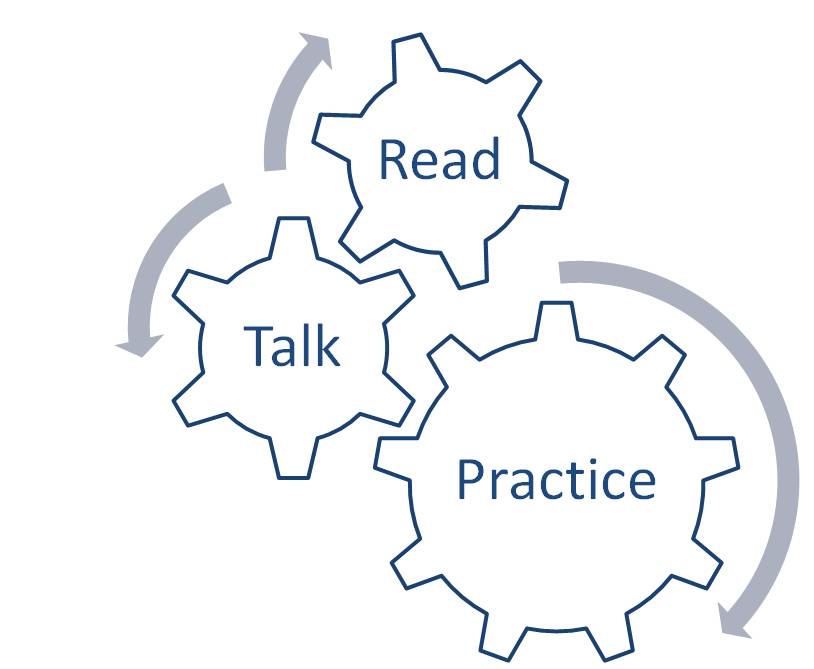
To make reading even more impactful, talk about what you are reading.  It is talking about books–with a constant eye for how it applies to our current work situation–that takes reading to the next level. This is in contrast to how many of us have experienced professional reading–as an individual activity.

As I engage with leaders, I like to recommend books that have made an impact on me.  And because I know the power of talking about books, I recommend that teams pick a book to read together.  Yes, like a book club!

When I was in the Army, we created something called the “Pro-Reading Challenge”–which boiled down to: Read a book and talk about it with your team. So simple, and yet so impactful.  It is the kind of simple leader development tool that any leader can put into practice.

This week I got an exciting glimpse into the impact of the Pro-Reading Challenge through a Twitter conversation.  Paul G. posted a message to his former company commander Joe B.:

Not long ago we were discussing this book in a small falafel stand in Mosul [Iraq]. Tomorrow, it’s my turn!

While commanding an Army unit in Iraq in 2010, Joe picked a book, The Past as Prologue: The Importance of History to the Military Profession, and talked about four chapters with his officers.  This, my friend, is leader development in action.  In the middle of a combat deployment!  Joe replied on Twitter with a picture of the four chapters highlighted in the table of contents of his copy of the book.  Paul replied with:

It was those 3 or 4 chapters that changed my outlook on studying history!

And here Paul is, five years later, reading and talking about the same book with his own team of leaders.  Creating time for talking about a book made the unit more effective in combat, it inspired a passion for studying history, and it role-modeled a leader development approach that Paul is now emulating.

So, what are you waiting for? Pick a book and engage in conversation about it with your team.  Focus on how it applies to your work.

And, have fun!
Storytime with Madelyn Blair

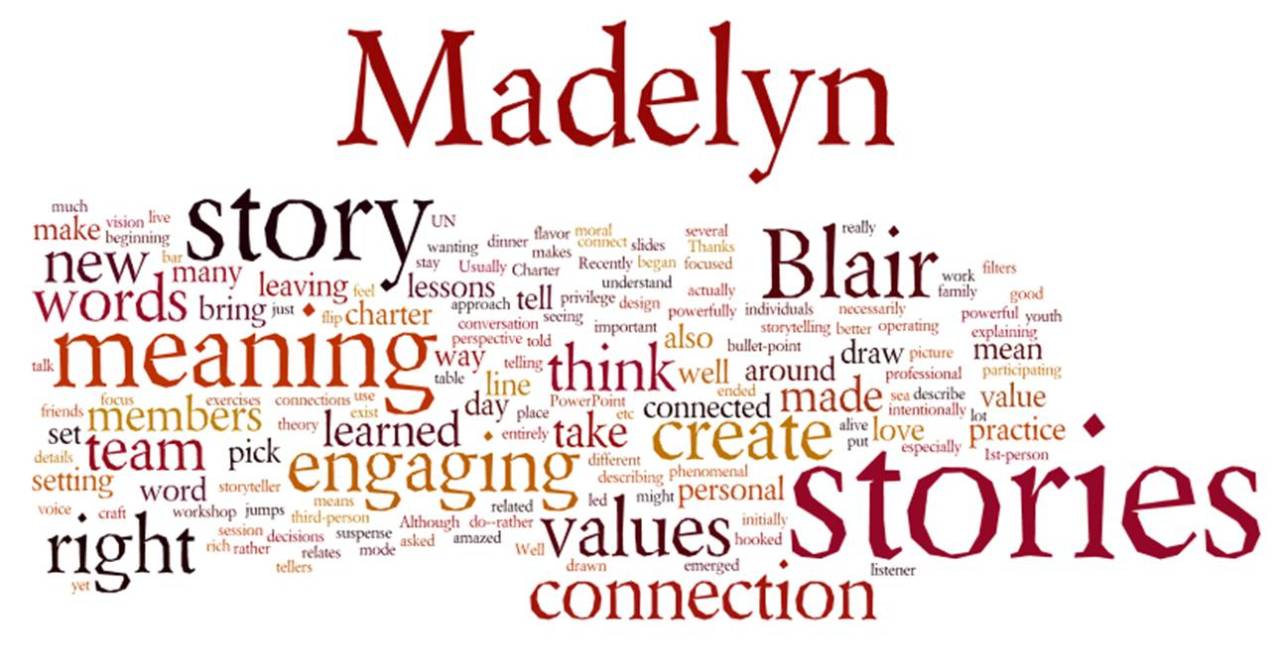
Recently, I had the privilege of participating in a workshop in which Madelyn Blair led us through several exercises focused around storytelling.  She began her session by telling a phenomenal story drawn from her youth.  She had us hooked with her voice, the rich 1st-person perspective, the details in the story, the suspense, etc.  AND, she ended at just the right place, leaving us wanting more; leaving us to draw connections and to make meaning of it for ourselves.  So many times, we jump right into explaining what the story means. Madelyn taught us that it is more powerful to design the story so that it engages the listener and makes her think about the “moral” or “so what?” for herself (or, better yet, also in conversation with each other).

Although “we live in a sea of stories,” we aren’t necessarily naturally good story tellers.  Maybe we are in the right setting (picture a bar with friends or around the family dinner table)–but to use stories in a professional setting?  Usually, we flip right into the third-person mode and focus on lessons learned and what “you” should do–rather than describing what “I” actually did. You can take away the PowerPoint slides, but many of us stay right with that bullet-point approach.
To take us from theory to practice, Madelyn had us practice.  She had us tell each other stories!  She told us that “stories are made up of words, and words are made up of stories.”  I love that line!  (That doesn’t mean I understand it, but I love that line!).  Using the UN Charter, Madelyn asked us to pick out a word in the charter and to think of a personal story to tell that relates to that word.  I was amazed at how much we not only learned about each other through the stories that emerged, but also how it connected us to the words of the charter in new ways.
This made me think about the team I work with.  We have a vision as well as a set of operating values that act as filters for the decisions that we make day to day.  The values really describe what is most important to us.  As we bring in new team members, we talk a lot about the values and what they mean to us.  Thanks to Madelyn, I’m seeing a new way to bring those values alive, especially for new team members that might not initially feel as connected to that set of values as are team members that were there in the beginning.  To pick a value and to craft a personal story related to that value could draw out new meaning and more powerfully connect individuals to those “words” as well as to each other.

***************

In addition to work with storytelling, Madelyn is passionate about understanding how successful people learn and stay on the cutting-edge–keeping their knowledge perpetually “fresh”–even as the world around us changes at a tiring pace.  She has written a book to capture some of her insights on this, which she titled Riding the Current: How to deal with the daily deluge of data.

The Knowledge Around You

The other day, I got a ride to Newark airport with Driven Eco, a really cool car service.  Just before I was picked up, I received a real downer of an email — one of those that sucks the life right out of you.  I was not in a small-talk mood.  Well, that is until the driver and I started talking.  Who would have known Ed  co-founded the company and is crazy passionate about entrepreneurship, social media and online conversation?  That was the quickest drive to Newark airport I’ve ever experienced.  By the time I was getting out, I loved this guy!  I walked away with no less than five book recommendations (Ed is a reading machine), invites to two cutting-edge online communities, several cool ideas, and a plan to connect again when I get back up that way.

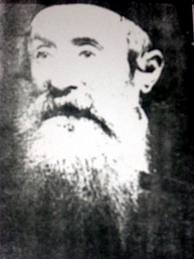
Are you wondering what the deal is with the picture of the rabbi?  So, I’m on the plane, at Newark, and who sits down next to me?  That’s right, a guy who looks just like this dude, only wearing spectacles.  I had just that morning done a google search on “Biblical Meditation” and found a site that described the original Hebrew words that ended up translated into the word meditation. Why you ask? That’s for another story.  But, I jumped on the chance to get this guy’s take on meditation.  I’ll boil his thoughts down to this:

The soul is the motivating force for action; the heart is the gateway to the soul; we have to get knowledge from our minds to our hearts, and it is meditation on God’s word and His work in our life that moves knowledge from our minds to our hearts — and, thus, without meditation, our souls never move us to action.

How about that?  Wow!

Is it possible that every person you come in contact with has a story? Some cool knowledge?  I’m glad I was paying attention on this day.