Corporations Don’t Want Leaders, But We Do

by George Purcell, guest blogger

More tears are shed over answered prayers than unanswered ones. —Truman Capote

In today’s environment it is fashionable to say we want leaders. Although I agree that we need leaders, especially to propel the economic engine of America, I see disconnects between what we are asking for and what we really want. Corporations say they want self-starters, creative thinkers—leaders—but do they really? I say no!

I recall a conversation in an elevator I once had with the CEO of the international corporation that I worked for. I was three months into a new role, having been brought from the field to corporate headquarters to, according to my bosses, bring a fresh perspective. The CEO asked me what my strongest impression was so far and I replied, “There are four or five hundred people we don’t need, employees whose daily activity is to try to find a purpose.” Word of that conversation spread and, before the day was over, I was counseled to be careful of my comments in elevators. “Employees should not raise taboo topics.”

The presiding wisdom in most corporations I have observed is that employees must pay their dues before their creative ideas will be embraced or encouraged. In the process of paying their dues, creative potential is sucked out of people. I experienced that in the days after my elevator conversation with the CEO. I became a tool not a thinker. The success I achieved after that came by explaining and selling the ideas of the top bosses. The corporation missed out on my creative ideas and the best ideas of many other leaders like me. Within a matter of a few years, the corporation was in financial trouble and reacted with a massive layoff.

This pattern of squelching creative ideas is, in my opinion, pervasive. It typically begins in the employee selection process. The personnel department looks for candidates who “fit the culture” – which is often code for “will not make waves.” We enthusiastically praise the values of creativity, innovation, and courage, but we hire and reward employees who agree with us.

The most talented employees nowadays don’t stick around when their ideas and opinions aren’t valued. They go to your competitor, or create their own business.

So, what do we do about this? How do you create the environment that counters the forces of bureaucracy that I described above? I will share one idea, something that gave me a lot of meaning personally.

Find and Develop the Best Leaders

First of all, hire great people. Take ownership of the process. You can have the best training program in the industry but if you hire a loser, you’ll just end up with the best-trained loser.

And the best way I’ve found to identify quality people is based on what they’ve done in the past—even if that is just in college. For example, ask, “Why is the University of Alabama a better place because you graduated from there? “Tell me about the leadership positions you sought out and the contributions you made?” Look past the interview skills (quick talker, tell you what you want to hear) and get to actual performance.

Show me what a man has done, and I’ll show you what he’ll do.

Additionally, stories about overcoming adversity tell us more about the character and leadership potential of a candidate than any psychological instrument ever will. As Warren Bennis and Rob Thomas have written, “The skills required to conquer adversity and emerge stronger and more committed than ever are the same ones that make for extraordinary leaders.” With this in mind, ask potential hires to describe their toughest life experiences, how they got through them, and what they’ve learned in the process. And for those candidates who don’t have a story to tell, well, it’s a mark against them in my book.

When you find someone with great potential, invest time in his or her development. I call these employees “developmental” or “high-potentials.” Spend time with them. Listen to them. They will need focus, but listen to them and encourage them to share their ideas, what they really think. The most disappointing thing to me is when you are hired and you have really creative ideas and the antibodies of the organization come after you. As a boss, you are in a position to block those antibodies and to nurture the creativity and initiative within your best employees.

This investment is not a nice-to-have; it’s a must have. If you don’t develop your key employees, your greatest talent will leave.

One of my main objectives was to promote great people. There was nothing more appealing to me than to advance others in the company and to contribute to their development. With this in mind, create a roadmap with each developmental employee, a step-by-step developmental program that you get your boss to review and approve. Look for opportunities for them to get a wide-variety of experiences that give them practice and exposure. For example, have them make a new product introduction presentation. Give them a project to lead. Have them represent you at an important overseas meeting. Get feedback comments from upper managers and add those comments to their file. Be their greatest advocate, even as you simultaneously push and challenge them.

We need leaders, but when you go inside most organizations you find cultures that undermine innovative, creative, risk-taking behavior. Our words are not aligned with our actions. Instead of throwing our arms up in despair, we need to lead by example in our spheres of influence. Take ownership of the hiring process and, once you identify talented employees, take responsibility for developing them. Create for them the kind of situation that you wish you had when you were starting out.

Tweet a Book: Why should anyone work here?

I started 2016 off by reading (and tweeting) Goffee and Jones’ new book, Why should anyone work here? What it takes to create an authentic organization. The idea of “tweeting a book” is to read a book cover to cover and tweet quotes as you go. The process causes me to read with greater focus, and I invariably get more out of the book as a result. You should try it!

This blog post captures all the tweets in chronological order and serves as a summary of the book.

INTRODUCTION

In their earlier book, Why should anyone be led by you?, Goffee and Jones call for us to be authentic and to be ourselves, more, with skill. This new book clarifies that organizations significantly influence our ability to be authentic (the “agency” vs. “structure” tension). It’s not enough for you to want to be authentic; your work culture either reinforces or undermines your ability to be your authentic self.

The way the authors moved into this book is by asking people the question, “What would your ideal organization be like? One in which you could be your best self.” And for leaders reading the book, the agenda is driven by this question: “How do you build the best workplace on earth for your people? How do you create the most productive and rewarding working environments possible?”

The authors’ research is organized around six imperatives for the ideal—or “DREAM”—organization, which is also how the chapters of the book are organized:

WhyWorkHere 2

It is a great book. I’ll turn now to the tweets, which are generally chronological beginning with the introduction and running through the six “DREAM” imperatives to the conclusion of the book.

TWEETS (@tonypburgess)

(140 characters or less, using #workhere)

January 3rd

“How do you build the best workplace on earth for your people?”

“This book is an agenda for ldrs & org’s that aim to create the most productive & rewarding working environments possible.”

“At a fundamental level, people want to do good work in org’s in which they believe.”

“People who enjoy what they do/where they work r more productive. Creating a gr8 place to work releases creativity/productivity”

This is a great insight to reflect on:

WhyWorkHere 1

January 4th

What would your ideal (“dream”) company be like? We start with the first imperative, DIFFERENCE:

“Creativity (a key index of performance) increases w/diversity & declines with conformity.”

“Authentic workplaces allow people to be themselves: to have a voice, exercise discretion, express disagreement…”

“Effective organizations are willing & able to leverage the wide range of differences among their people.”

Yet, there’s a tension (trade-off) between fostering individuality/uniqueness on the 1 hand & cohesion/structure on the other

January 6th

“Inherent differences among them generate conflict, which feeds creativity & high engagement. And while most org’s say…” (1/2)

“…they want creativity/innovation [they don’t want] the passionate conflict, edgy relationships & regular failure” often involved (2/2)

“The forces 4 conformity in org’s r strong…Consciously push against that magnetic draw…so people can be who they really r.”

“When a person is able to express his or her uniqueness, both the individual & the org win.”

“Efforts to nurture individuality run up against countervailing efforts to increase org effectiveness…”

Here are my rough notes on Chpt 1 in Goffee & Jones’ new book #workhere? #difference So, where does this leave us?

WhyWorkHere 3

January 7th

On to Goffee & Jones’ 2nd ideal org imperative, Radical Honesty: “I want to know what’s really going on.”

“Transparent honest practices r now seen as the #1 factor in creating corporate reputation. Radical #honesty is a biz necessity.”

#honesty is proactive; speedy; surprises people with its candor; encourages dissent; engages with employees & wider stakeholders.

January 8th

“Power relationships at work distort communication…& explains why much of the info that reaches senior execs is sanitized.”

“People need to feel safe imparting their views…There’s a need to invent mechanisms to ensure it’s ok to surface problems.”

Examples: Have meetings specifically designed to air bad news; have “hopes & fears” discussions.  Openness is a key ldrshp skill.

January 9th

Goffee & Jones’ 3rd imperative for great organizations is “Extra Value” — invest in people & magnify their #strengths.

“The ideal company doesn’t just grow its best employees; it makes all its employees better than they ever thought they could be.”

“Adding value to employees & generating value as an org. are not competing activities. They are symbiotic.” #virtuouscycle

“Join us & we will develop you.” We will help magnify your strengths! This is a powerful commitment for org’s to make.

A question for leaders to consider: “How do you magnify your team members’ #strengths?” Well, first you have to know what they are. Right?

January 11th

Goffee & Jones’ 4th imperative for the ideal org is about standing for something real #authentic

What does it mean for an org to be #authentic?

WhyWorkHere 4

January 12th

#authentic org’s “possess a sense of identity; they obsessively live their values; & their leaders model the company’s values”

Ldrs: be #authentic! “Be yourself, more, with skill.” Know & use your distinctive differences & the weaknesses that make u human

January 14th

“Human beings r empowered by seeing the connection between biography & history…” Do u make that connection in ur organization?

“Does ur org have identity-defining roots? U don’t have to be old to have roots.” How do u tell the story of ur org’s origins?

After giving 3 great ex’s of org HQ reflecting their identity: “Too many [others] convey nothing of the org’s history & culture.”

“The fact is that people want to work for an organization that stands for something.” #workhere #authentic Stand for something real.

January 15th

On to Goffee & Jones’ 5th imperative for the ideal org: “make it meaningful”

How do #leaders ensure the daily work is intrinsically satisfying & meaningful? the 3 C’s: #connection, #community, #cause.

January 16th

Refuse 2 be restricted by the limits of ur role. “Design jobs that allow individuals greater scope for self-expression” #meaning

“What we have before us are some breathtaking opportunities disguised as insoluble problems.” -John Gardner

January 17th

“The paradox of team building: when u build strong teams u may exclude others. Thus, it becomes a ldrshp imperative…” (1/2)

“…as u build a strong team, to also build the #connection to adjacent functions & the wider organization.” (2/2)

“High levels of #sociability at work fuel: creativity, enjoyment & effort.” #relationships

“Where levels of sociability & solidarity r high we describe the org culture as communal” Passion, loyalty & obsession r the norm

January 18th

“THE most significant source of meaning for talented people comes from a shared cause or sense of purpose.” What is yours?

“If co’s organized more 2 draw on & fuel enthusiasms &less 2 maximize efficiency the problem of disengagement would b gone 4ever”

“The task of the Ldr is 2 identify what’s exciting about work & 2 convey it 2 others. Do this well & the energy can b infectious”

“If we want people to fully identify with their org’s & to bring their best selves to work, they need a sense of cause”

“What’s increasingly clear is that identifying the cause may well take u beyond the boundaries of the org to wider communities.”

January 19th

#leaders “We have the opportunity-indeed the obligation-to build a sense of belonging & cooperation.”

January 20th

On to Goffee & Jones’ 6th & final imperative for the ideal org. Have #SIMPLE, widely-agreed on rules.

“The ideal co is not a co w/out rules. It has clear rules that make sense to the people who follow them.” Clarity & Simplicity

“Good rules maximize discretion which, in turn, facilitates problem solving. They unleash initiative rather than suppress it.”

The tendency is toward rule creep & before u know it rule proliferation & complexity, which often leads to reduced profitability.

“Good rules connect to purpose.” What are the rules in your org? Is it clear how they connect to ur org’s #purpose?

“When things go wrong, resist the temptation to invent another rule.” Revisit values & purpose & “strive for simplicity” #trust

January 21st

Just finished Goffee & Jones’ book, “Why Should Anyone Work Here?” #whyworkhere? I’ll close with a few standout quotes from the Conclusion.

“Allowing people to be themselves generates commitment & fosters creativity.” It’s not always easy “but there is a major pay-off”

“Where work feels meaningful, individuals experience a sense of purpose. They can find intrinsic meaning in their jobs…” (1/2)

“…in the way their work connects 2 others & the broader community. They can connect what they do 2 an overarching cause.” (2/2)

“Rethinking our org’s is not just about profit, efficiency, or effectiveness; it’s about crafting recipes for good societies.”

People want “Org’s where they can be themselves, know the truth, grow, believe in the purpose & be given the freedom 2 pursue it.”

NOTE: This last tweet nicely captures Goffee and Jones’ six imperatives for the ideal (DREAM) organization: (1) Be Themselves (Difference); (2) Know the truth (Radical Honesty); (3) Grow (Extra Value); (4, 5) Believe in the purpose (Authenticity & Meaning); (6) Given the freedom to pursue it (Simple rules).

*****

CLOSING COMMENTS

Goffee and Jones emphasize several times that it is rare to find organizations achieving excellence in all six imperatives.  They include a short questionnaire in each chapter that leaders can use to help assess where they stand with each of the imperatives, and they recommend focusing effort on addressing the weakest areas first.  Several of the imperatives are synergistic and reinforce each other; however, some can actually be at odds.  For example, a company with strong identity and cohesion – which are linked to authenticity and meaning – can work against valuing difference. These tensions are good for leaders to be aware of.

Finally, a big idea that is worth repeating is that individual agency to “be authentic” is influenced by the structure of the workplace – the organizational culture. We need cultures that call out authenticity and that allow us to be our best selves.

Why Should Anyone Work Here (Cover)

Book Citation: Goffee, Rob and Gareth Jones (2015). Why should anyone work here? What it takes to create an authentic organization. Boston, MA: Harvard Business Review Press.

Follow me on Twitter

tonypburgess on Twitter

When You Don’t Know What To Do

Good decisions come from experience. Experience comes from making bad decisions. –Mark Twain (1835-1910)

You typically know the right thing to do.  At most decision points, what’s needed is discipline or the courage to act.  But every once in a while you arrive at a decision point when all your choices have the potential to backfire. When every option has serious repercussions. What do you do?

Add time pressure, an overbearing boss, or a zero-defects company culture to the mix. Now it feels like swimming in a 10 foot-deep pool of half-dried cement. These are the moments that cry out for leadership—your leadership.

Dilemma: a situation in which a difficult choice has to be made between two or more alternatives, especially equally undesirable ones.

How do you swim through a pool of half-dry cement? How do you make a decision when faced with a dilemma?

It can be immensely helpful to have a framework—a way of thinking—to help you move forward. Here is one approach:

1. What is the issue, really? First, clarify the issue. In the messy reality of a difficult decision, less pertinent issues may mask the main issue. If there are multiple issues, separate them; lay them out so that you can see what is going on and clarify what the crux of the matter is. I am a visual learner, so it helps me to visually depict the situation on paper. You may prefer to make lists in a spreadsheet or to visualize it in your mind’s eye.

Clarifying the issue also helps to identify who on your team to get involved.

2. Activate the team! You may have to go it alone, either because of the nature of the dilemma or because of time sensitivity. If you have time and it is appropriate to get others involved, do it. Call your team in and get their take on things (see #’s 3-5 below). Getting them involved will give you new perspectives, will cause them to be more vested in the decision, and will develop their own leader judgment—setting the conditions for them to be more effective leaders.

You can also talk it through with a mentor or other trusted person. Hearing yourself explain the dilemma to an outside, dispassionate leader often reframes the situation; and bringing in a mentor can help make sure you aren’t missing something important. And if there is no time or you feel the nature of the dilemma requires total discretion, then talk it through with yourself!

3. Find out as much as you can. Two maxims to remember: “First reports are always wrong” (or, at best, incomplete), and “there are always two sides to every story.” So, suspend judgment and learn as much as you can. Physically go to the “scene” and talk to the key players right away. If the problem is related to a specific person, talk directly with him or her and hear it from the “horse’s mouth” rather than through someone else.

Trust: Your default should be in support of your employees until you gather all the information. You have the opportunity to engender trust by believing in your people, even when everything initially seems to point against them. If you believe the initial negative report only to find out later that your employee was in the right, you will never recover the lost trust.

4. What are your choices? What can you do? You’ve clarified the issue and gotten as much input as possible. Now it’s time to lay out all your possible choices and test them. Play them out in your mind and think through the potential consequences of each choice. Can you live with the worst-case scenario? What are the pros and cons and how do they fit in with your personal beliefs, regulations, the norms of the organization, and the norms and values of the larger profession?

And, my favorite question to ask yourself: What do I want to accomplish or create long-term? Clarity on this question will affect the way you act in the here and now. Think about the impact your decision will have, both on individual employees and the organization in general. Your actions, especially when the pressure is on you, will speak loudly. You are making history and the story will be told and retold by your employees. Make sure that the history you make is aligned with the vision you have for the organization.

5. Decide, execute and evaluate. Given the information that you have available, make the best decision you can and move forward with confidence. Execute! When appropriate (which is most of the time) explain to your team how you came to your decision. Do not assume that they know what is going on in your head.

Once you take action, continue to assess the situation and take in additional information. If the facts and circumstances change, don’t stay locked into a decision that is no longer valid. Be big enough to change your decision if the circumstances warrant.

And if things go horribly wrong, which you know can happen in a true dilemma, be humble. Activate your team, find out as much as you can, trust your people, and press forward.

Equipped with a framework like this, you may discover that the morass of cement feels more like water, and moving forward becomes easier. As you respond to the cry for leadership in these moments, you will hone your judgment and gain the wisdom that comes from experience.

Follow Tony P. Burgess on Twitter to stay connected. tonypburgess on Twitter

What Do You Want Most In A Leader?

This is a quick leader development exercise that always makes a positive impact.  It’s perfect for a “Lightning LD” (that’s a quick, yet impactful, leader development session with your team), and can be done, for example, over lunch.  Ask your team members:

  • What attributes and/or competencies do you want most in a subordinate leader? [Brainstorm out as many as you want, but then select the top 3-5 in rank order]

Have them think and write on their own (individually).  After a few minutes, shift their focus and ask:

  • What attributes and/or competencies do you want most in a boss? [Brainstorm out as many as you want, but then select the top 3-5 in rank order]

After a few more minutes, have a conversation.  Ask them to share their lists and to explore their thought process.  Facilitate a conversation about the similarities and differences across your team.  And draw attention to someone who has a different list for a subordinate and a boss.  Use that observation to dig into the why behind the lists being different.

Wait a day or two and ask your team several follow-up questions:

  • Given what you said you value most in a subordinate and boss, how would your current boss assess you as a subordinate?
  • How would your current subordinates assess you as a boss? In other words, turn your own criteria around on yourself.
  • And, how are you putting this into practice?

Have a conversation, and see where it goes. The greater challenge really is not to decide on the “right” top five attributes/competencies; rather, it is to act on them–to put them into practice.

For more insight about how you can use this idea with your team, read two previous blog posts describing a similar process with a group of West Point cadet leaders:

(1) What Do You Want In A Leader, Part 1

(2) What Do You Want In A Leader, Part 2

It is in the perfectly disciplined will

Vince LombardiThis is a special 3-minute video featuring legendary Coach Vince Lombardi.

Coach Lombardi is best known for coaching the Green Bay Packers to five NFL Championships in seven years, and is widely considered the best football coach of all time.

He also, by the way, was an assistant coach at West Point (Go Army!) for five years under Earl “Colonel Red” Blaik.  Those years were formative for Lombardi.

Of all the amazing quotes captured in this video, this one really stands out to me:

“The new leadership is in sacrifice, it is in self denial, it is in love, it is in loyalty, it is in fearlessness and humility, and it is in the perfectly disciplined will. This is not only the difference between men, this is the difference between great and little men. Thank you.” –Coach Vince Lombardi

Are you fired up!

Shackleton’s Call

Sir Ernest Shackleton was a British explorer who famously led an expedition in 1914 to cross the Antarctic continent.  Their ship, “The Endurance,” was aptly named given the absolutely epic challenges the 27 crewmen overcame on the trek.  

When Shackleton was preparing for the mission, he published an advertisement in the London newspaper: 

“Men wanted for hazardous journey.  Small wages, bitter cold, long months of complete darkness, constant danger, safe return doubtful.  Honour and recognition in case of success.”

I love this!  It appeals to me.  It connects with a part of me that doesn’t often get called upon.  What can we learn from this?  Is there opportunity for leaders today to create this kind of a call?  What would that even look like?

What do you think?

If you want to learn more about Shackleton, get this DVD, narrated by Liam Neeson.  It is incredible!  Absolutely inspiring!  And it is a great catalyst for conversations about leadership.

Why Should Anyone Be Led By You?

This is a great ten minute video with Rob Goffee and Gareth Jones relating the research that went into their fantastic book, Why Should Anyone Be Led By You.

Followers want:

  • Community
  • Authenticity
  • Significance
  • Excitement

Questions to ask yourself:

  1. What does it mean to be a community builder as a leader?
  2. Are you authentic?  Do you take your real self to work? Authentic leaders know themselves and “show” themselves — they aren’t perfect — and they genuinely want the best for their followers and the organization.
  3. Do you appreciate your followers’ contribution? Are you a source of significance for your followers?
  4. Are you a source of energy, edge, and passion — genuine excitement — for your team?
  5. Who decides?  (not you! Your followers decide)
Reflection: I love the connection between this 4th question about excitement and the question that Bob Sutton shared that Rob Cross asks: “After you talk to this person, do you have more or less energy?”  I aspire to be the kind of person that gives people more energy.  How about you?  Positive. Inspired. Energized.  Let’s serve up some pie!

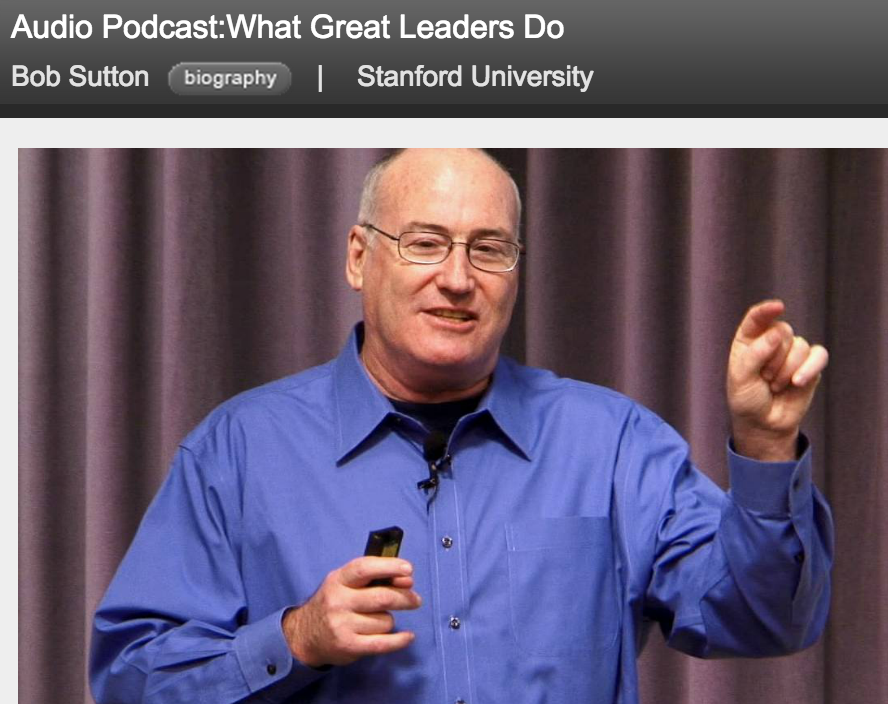
What Great Leaders Do (Bob Sutton Presentation at Stanford University)

Bob Sutton PODCASTYou may have heard of Bob Sutton through his books, like: The No Asshole Rule and The Knowing-Doing Gap.

In this audio PODCAST, Bob talks about his latest book, Good Boss, Bad Boss. Although leaders account for a measly 15% of the results in groups, they get 50% of the credit.   And when you put a person in a position of power, they:

  1. focus more on their own needs and concerns
  2. focus less on the needs and concerns of their subordinates
  3. act like the rules don’t apply to them

This is a phenomenon of human nature.  When you become “the boss” — or become successful — let it be a warning to you because, based on a lot of evidence, you are about to become an “idiot.”

Bob goes on to describe characteristics of in-tune bosses (best bosses):

  • They are assertive when they need to and back off when appropriate (i.e., not always the dominant assertive type)
  • They don’t constantly check on their subordinates; rather, they give them space.  They practice management by walking out of the room. Quote: “After you plant a seed in the ground, you don’t dig it up every week to see how it’s doing.” This is especially important in creative work.  If you keep checking up on your subordinates, they tend to start focusing on pleasing you and not doing the deeper work that the organization needs them to do (and you really want them to do).
  • They are confident and competent, AND they are open for input.  They walk the line between the two.  They practice an attitude of wisdom: They have courage and confidence to act on what they know right now along with the humility to update when new information comes along.

At the 34:30 mark in the talk: “Rotten Apples” and how important it is to get rid of them.  Bob shares the “5 to 1 rule”: if you are in a personal relationship with someone and you go below 5 to 1 – where for every bad interaction there aren’t at least five positive interactions, the relationship is in trouble.  When you have a bad interaction with someone, it packs 5x the power of a good interaction. When teams have one rotten apple, it knocks down the team performance by at least 30%.  It is contagious.  When you work with jerks, you start acting like them.  When you have a high-maintenance person, you spend more time working with their quirks and less time actually doing the work.

A good boss is a human shield.  “He or she has got my back.”  “Managers are people who see visitors so the others can get the work done” (Mintzberg).  Good bosses protect their people from all kinds of intrusions, interruptions, etc. – and they protect their people from “idiocy from on high.”
There’s a great question from Rob Cross at the end of Bob’s talk: “After you talk to this person, do you have more or less energy?”  Bob leaves us with this question: “How do people feel after they talk with you?”
Reflection: I thought this was a really nice tie in to the Leader-Member-Exchange (LMX) discussion we’ve been having because Sutton’s focus is on leader-subordinate interactions and relationships.